My Child Hates Reading: 9…
November 24, 2026



Your four-year-old bolts from the bookshelf. Your seven-year-old announces “I hate reading” the moment homework comes out. If your child hates reading, you haven’t failed, and it isn’t a lost cause.
Scholastic’s 2023 Kids & Family Reading Report found that 46% of US children aged 6–8 read books five or more days a week. By ages 9–11, that dropped to 32%. Reading for fun fades as kids grow, so the early years are your best window to make books feel like a treat, not a task.
(Methodology: Scholastic/Fluent Research, nationally representative US sample of 1,724 parents and children, surveyed December 2022 to January 2023.)
Reluctance almost always has a reason underneath. Find yours before you try fixes.
Reading is hard right now. A child still sounding out letters spends every ounce of energy on mechanics. By the end of a sentence, the beginning has vanished. That isn’t boredom. It’s fatigue.
Books have become a test. Every read-aloud turns into “What does that say? Sound it out. Try again.” Children learn fast that books mean being corrected.
Something louder is competing. Screens hand out instant rewards. A picture book asks for patience, and patience is a skill, not a personality trait.
The books don’t fit. A child obsessed with trucks won’t care about the fluffy bunny you picked.
Watch for a week. When exactly does your child resist? Before the book comes out, halfway through a page, or only at homework time? Your answer tells you which of the nine ideas below to start with.
Start with five minutes. One page counts. Stop while your child still wants more, and do it on purpose. Ending early leaves them hungry for tomorrow, while a forced 20-minute slog teaches them to dread it.
Once five minutes feels easy for about two weeks, stretch to eight, then ten. Let your child’s mood set the pace, not the clock. Some evenings will stay at one page, and that’s fine.
Take them to a library or bookshop and let them pull whatever they like. Joke books, comics, a book about drains. Rereading the same story for the fortieth time isn’t laziness either. Familiar words build fluency and a feeling of “I can do this.”
Keep a small pile within reach of the sofa, the bed and the car.
The American Academy of Pediatrics’ 2024 policy statement encourages parents to read aloud from birth and frames it as a way to build warm, nurturing relationships, not just literacy. Nothing in that advice says to stop when your child turns six.
A seven-year-old who can’t yet read a chapter book alone can still love hearing one. Choose stories slightly above their level and stop at the cliffhanger.
Pause and ask. “What do you think happens next?” “Where is the dog hiding?” “Have you ever felt like that?” Let your child tell the story from the pictures while you play the curious listener.
This style is called dialogic reading. The US What Works Clearinghouse reviewed it and rated its effect on preschoolers’ oral language as positive (five qualifying studies, 351 children, 2007 review). Its effect on phonological processing was not discernible. So conversation grows vocabulary and confidence, but letter sounds still need their own practice (see #7).
Swap pages: you read one, they read one. Or let them read only the words they know, like “the,” “is,” “cat,” while you handle the rest.
Don’t correct every slip. If your child says “puppy” for “dog,” the meaning survived, so let it go. Note the tricky word and revisit it later through a game, not mid-story.
5 common mistakes parents make while teaching phonics
Cricket, dinosaurs, space, bangles, buses. Fact books, magazines, cricket scorecards, recipe cards and cereal boxes are all reading. A child who reads about what they love is building the habit, and the habit matters more than the genre.
We’d skip sticker charts for reading. They quietly tell a child that reading is the price you pay to get the prize.
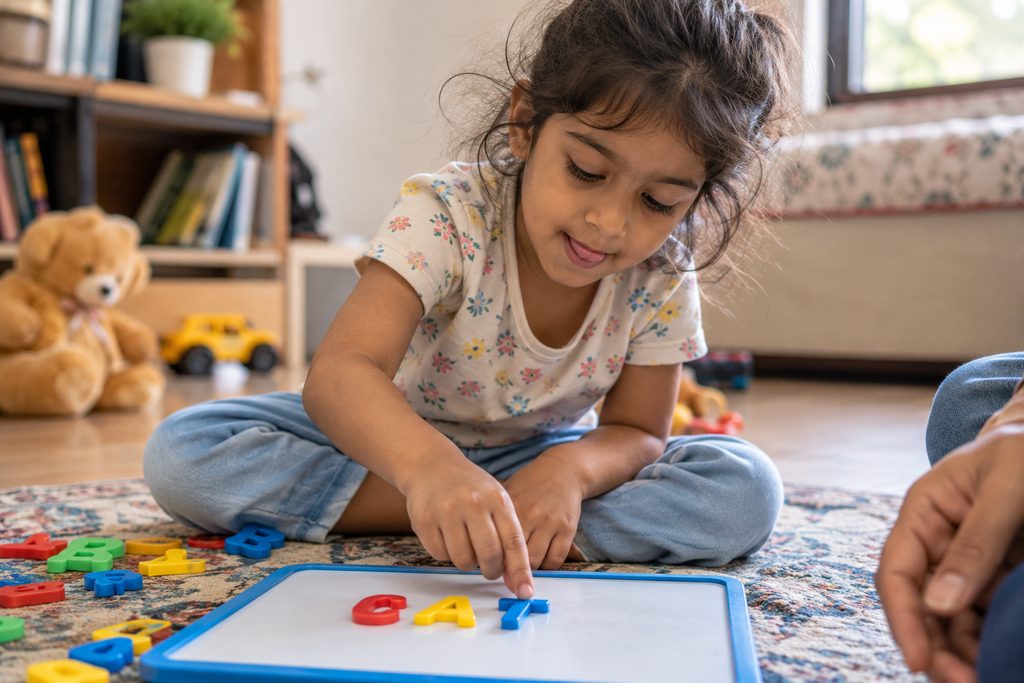
Resistance often hides a gap in letter sounds. Fix it with games, not worksheets. Play “I spy” using sounds (“something that starts with /s/”). Hunt the house for objects beginning with /m/. Build simple CVC words (consonant-vowel-consonant, like c-a-t) with magnetic letters, then slide the sounds together.
Our guide to CVC words in phonics walks through this step by step. A child who blends their first three-letter word feels like a reader, and that feeling is fuel.
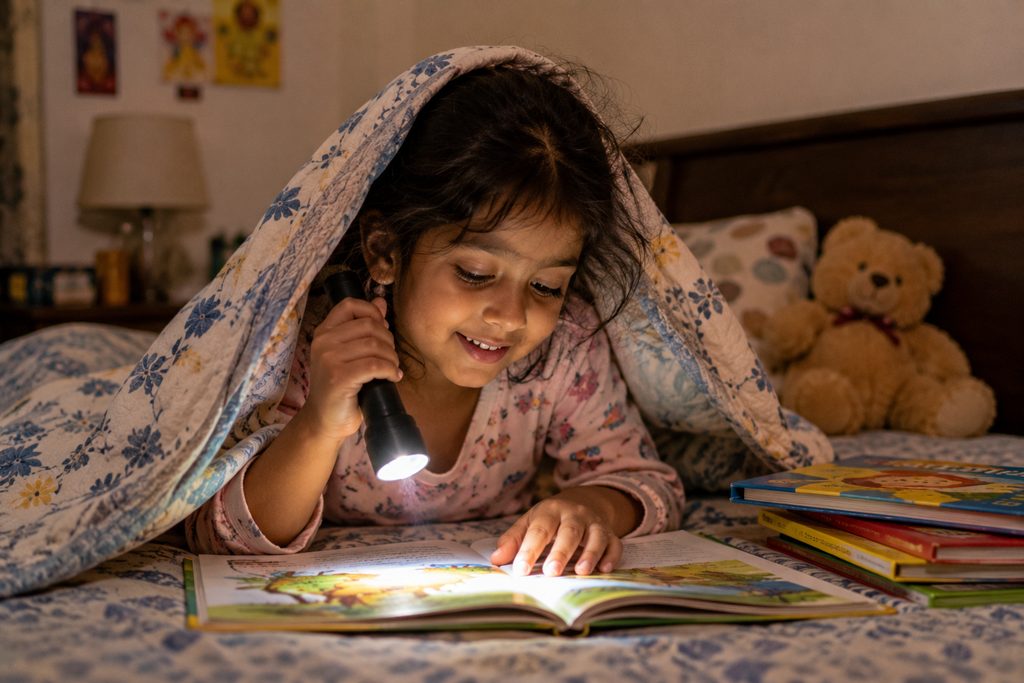
Same time, same spot, a blanket and a torch. Ten minutes at bedtime is plenty. The AAP recommends print books filled with colourful pictures where possible, noting that touchscreens tend to be passive or solitary and digital books don’t encourage the same back-and-forth between parent and child.
If you do use audiobooks or e-books, talk about the story together as you go.
Children copy what they see. Read a newspaper, a novel or a recipe where they can see you. Read out a funny line unprompted. Praise effort, not speed: “You finished a whole page today” lands better than “You’re getting so fast.”
Better still, build reading into the day without calling it reading. Ask your child to find the lift button marked “G” or read the name on the milk packet. Small wins like these happen away from the bookshelf, where the pressure lives.
The words you choose in that moment matter more than the strategy behind them. Compare two responses.
“Don’t say that. Reading is important.” This shuts the conversation down and confirms that books are an adult agenda.
“Sounds like reading feels annoying right now. What’s the annoying part?” This opens a door. Children as young as four can tell you the pages are too long, the words are tricky, or they’d rather be outside.
Whatever they say, offer a choice rather than an order: “Do you want me to read, or shall we take turns?” or “Bedtime story first, or after your bath?” Choices give a small person some control, and control is often what the refusal was really about.
If the answer is a flat no, let it go for the evening. One missed night costs nothing. Arguing about it every day costs a lot.
| Age | What works best | What to skip |
| 3–4 | Picture books, rhymes, pointing out print on signs and packets | Pushing letters or flashcards |
| 4–5 | Letter-sound games, favourite books on repeat, “reading” from memory | Correcting pretend reading |
| 5–6 | Blending CVC words, short decodable books, turn-taking | Long sessions, comparing with classmates |
| 6–8 | Chapter read-alouds, comics, series books, reading to a pet or younger sibling | Making reading homework-only |
Give the gentle approach a few months. If your child still avoids books, struggles to connect letters to sounds, can’t hear rhymes, or forgets words they learned yesterday, talk to their teacher. A paediatrician or learning specialist can also check vision, hearing and other needs that quietly make reading harder.
Seeking help early isn’t an overreaction. It simply means your child gets the right support while reading is still new.
Why does my 5-year-old refuse to read?
Usually it’s difficulty or pressure, not dislike of stories. Check whether letter sounds feel shaky, whether sessions feel like tests, and whether the books suit your child’s interests. Shorter, lighter sessions often change the mood within weeks.
Should I make my child read every day?
Make the routine daily, but keep it small. Five relaxed minutes with a book your child picked beats a forced twenty. Missing a day isn’t a crisis. Dreading the habit is the real risk.
Is it okay if my child only reads comics?
Yes. Comics build vocabulary, sequencing and the habit of picking up something to read. Mix in other formats gradually, and keep reading aloud from longer stories alongside.
Do audiobooks and e-books count?
They can help, but the AAP prefers print for young children, with conversation around any digital or audio story. Talk about characters and predictions together instead of handing over a device.
Is it normal for a 3-year-old to dislike books?
Very. Three-year-olds have short attention spans and big opinions. Try rhymes, lift-the-flap books, or books about things they already love, and keep sessions to a few minutes.
Of everything here, two habits matter most: let your child choose, and keep the pressure off. Reading enthusiasm grows in small, warm moments, not in forced chapters.
If you suspect shaky letter sounds are behind the resistance, structured help can make a difference. iSchooling’s online phonics classes teach the 42 English letter sounds through live, multi-sensory lessons for children aged 3 to 8. Have questions about the right level for your child? Get in touch with our team and we’ll point you in the right direction.


